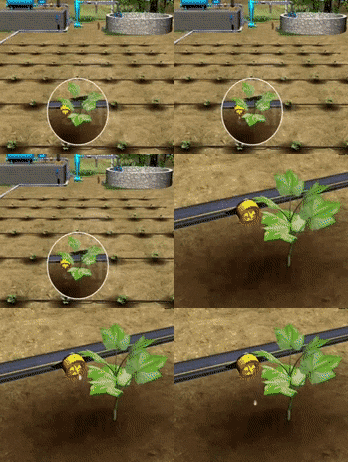
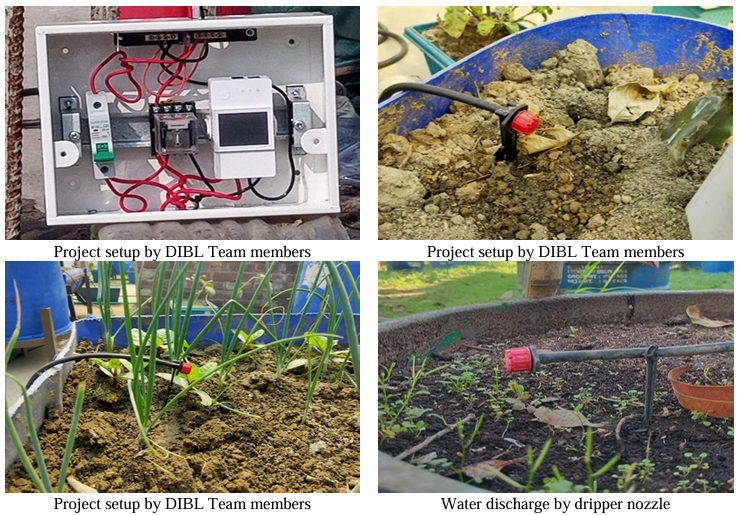


Drip irrigation delivers water drop by drop to the root zone of each plant, exactly as needed. It is very effective for watering any plant with very little water, for example rooftop gardens, orchards and vegetable farming.


You can water any plant with very little water, for example rooftop gardens, orchards and vegetable farming.
Drip irrigation mainly comes in two types.
1) On-line dripper: these drippers are separate units that are fitted to the drip pipe by punching a hole, placed at the base of each plant. They deliver 2 L/H, 4 L/H or 6 L/H. Choose the dripper according to the plant water need. There are also adjustable drippers where you can turn the flow up or down by hand.

Use: works well for rooftop gardens and orchards. Adjustable drippers suit mixed plants on a rooftop. For thousands of plants in a field, 2 L/H, 4 L/H or 6 L/H drippers work well.

2) In-line dripper: here the drippers are built inside the drip pipe or tape, for example every 20, 30 or 40 cm. They deliver 2 L/H, 4 L/H or 6 L/H. Choose the drip tape according to your plant spacing and water need.


Drip irrigation does not need much water pressure. It works if the water tank is 2 metres (7 feet) above the plants. To water many plants at once you need a taller tank or a suitable pump.
For example, to give 1 litre to each of 1,000 plants in 10 minutes you need a pump that delivers 1,000 litres in 10 minutes.
Whether you need a filter depends on your water quality. If your water has no dirt or chemicals such as iron, you do not need a filter.
If there is ordinary dirt, use a screen filter.

For better filtration use a disc filter.

If the water has sand, use a sand filter or a hydro-cyclone filter.


For chemicals such as iron in the water use an iron filter. If there is only a little, a sand filter will do.
What happens if you do not use a filter?
Dripper holes are very small and fine. Anything in the water can block them and clog your whole drip irrigation system.
Fogging means putting water under pressure to turn it into a very fine mist mixed into the air. It quickly lowers the temperature and raises air humidity. Fogging is an effective, low-cost method. 
Fogging is an effective, low-cost way to lower temperature and raise humidity, so it has many uses, for example:
1) Controlling temperature in cattle sheds 
2) Raising humidity for mushroom farming

3) Orchid flower farming

Drip irrigation mainly comes in two types.
1) On-line dripper: these drippers are separate units that are fitted to the drip pipe by punching a hole, placed at the base of each plant. They deliver 2 L/H, 4 L/H or 6 L/H. Choose the dripper according to the plant water need. There are also adjustable drippers where you can turn the flow up or down by hand.
Use: works well for rooftop gardens and orchards. Adjustable drippers suit mixed plants on a rooftop. For thousands of plants in a field, 2 L/H, 4 L/H or 6 L/H drippers work well.
2) In-line dripper: here the drippers are built inside the drip pipe or tape, for example every 20, 30 or 40 cm. They deliver 2 L/H, 4 L/H or 6 L/H. Choose the drip tape according to your plant spacing and water need.
Drip irrigation does not need much water pressure. It works if the water tank is 2 metres (7 feet) above the plants. To water many plants at once you need a taller tank or a suitable pump.
For example, to give 1 litre to each of 1,000 plants in 10 minutes you need a pump that delivers 1,000 litres in 10 minutes.
Whether you need a filter depends on your water quality. If your water has no dirt or chemicals such as iron, you do not need a filter.
If there is ordinary dirt, use a screen filter.
For better filtration use a disc filter.
If the water has sand, use a sand filter or a hydro-cyclone filter.
For chemicals such as iron in the water use an iron filter. If there is only a little, a sand filter will do.
What happens if you do not use a filter?
Dripper holes are very small and fine. Anything in the water can block them and clog your whole drip irrigation system.
Sprinkler irrigation spreads a small amount of water over a wide area using a pump. It can be called artificial rain.
You can water any plant with very little water, for example rooftop gardens, orchards and vegetable farming.
Drip irrigation mainly comes in two types.
1) On-line dripper: these drippers are separate units that are fitted to the drip pipe by punching a hole, placed at the base of each plant. They deliver 2 L/H, 4 L/H or 6 L/H. Choose the dripper according to the plant water need. There are also adjustable drippers where you can turn the flow up or down by hand.
Use: works well for rooftop gardens and orchards. Adjustable drippers suit mixed plants on a rooftop. For thousands of plants in a field, 2 L/H, 4 L/H or 6 L/H drippers work well.
2) In-line dripper: here the drippers are built inside the drip pipe or tape, for example every 20, 30 or 40 cm. They deliver 2 L/H, 4 L/H or 6 L/H. Choose the drip tape according to your plant spacing and water need.
Drip irrigation does not need much water pressure. It works if the water tank is 2 metres (7 feet) above the plants. To water many plants at once you need a taller tank or a suitable pump.
For example, to give 1 litre to each of 1,000 plants in 10 minutes you need a pump that delivers 1,000 litres in 10 minutes.
Whether you need a filter depends on your water quality. If your water has no dirt or chemicals such as iron, you do not need a filter.
If there is ordinary dirt, use a screen filter.
For better filtration use a disc filter.
If the water has sand, use a sand filter or a hydro-cyclone filter.
For chemicals such as iron in the water use an iron filter. If there is only a little, a sand filter will do.
What happens if you do not use a filter?
Dripper holes are very small and fine. Anything in the water can block them and clog your whole drip irrigation system.
On-line dripper: these drippers are separate units that are fitted to the drip pipe by punching a hole, placed at the base of each plant. They deliver 2 L/H, 4 L/H or 6 L/H. Choose the dripper according to the plant water need. There are also adjustable drippers where you can turn the flow up or down by hand.

Use: works well for rooftop gardens and orchards. Adjustable drippers suit mixed plants on a rooftop. For thousands of plants in a field, 2 L/H, 4 L/H or 6 L/H drippers work well.
In-line dripper: here the drippers are built inside the drip pipe or tape, for example every 20, 30 or 40 cm. They deliver 2 L/H, 4 L/H or 6 L/H. Choose the drip tape according to your plant spacing and water need.